
Overview
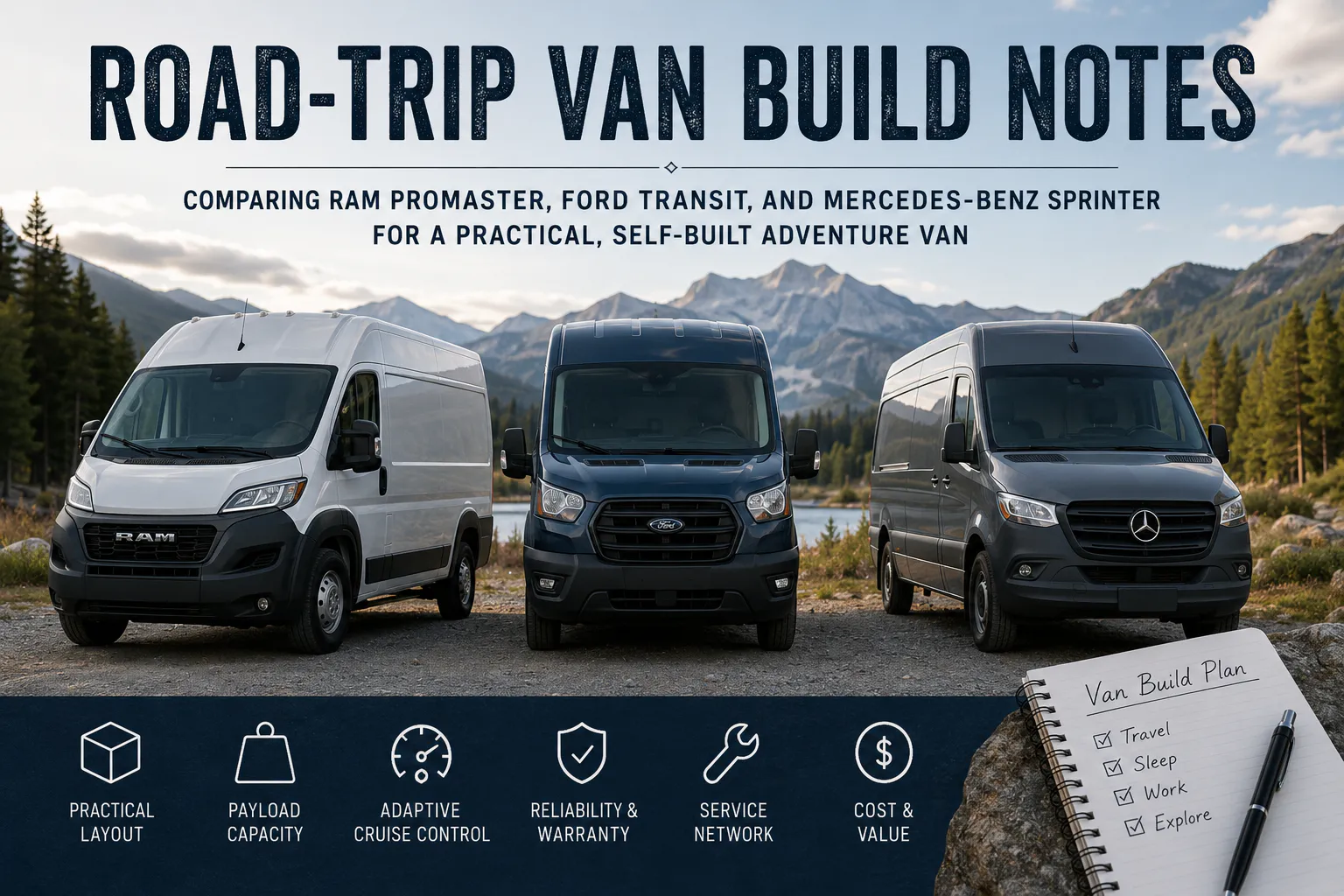
These notes compare three high-roof cargo van platform options for a practical road-trip and utility build:
- Ram ProMaster
- Ford Transit
- Mercedes-Benz Sprinter
My goal is not to build a full-time recreational vehicle or a luxury camper. My goal is to start with a reliable, serviceable cargo van that can be built out gradually for road trips, occasional sleeping, basic hygiene, toilet access, storage, and remote work.
My expected use case is sometimes solo travel, sometimes with my wife, and sometimes with my son. I expect to stay in hotels a meaningful portion of the time, use campgrounds sometimes, and occasionally camp more simply. The van should provide flexibility when I want to sleep, work, take a break, use a toilet, clean up, or avoid depending completely on hotels and campground facilities. I do not expect to spend much time on unmaintained roads or intentionally travel in severe weather, although I want the vehicle to remain capable enough for normal cross-country travel, mountain highways, campgrounds, and poor-weather contingencies.
The vehicle should remain reasonably maneuverable and should not become a large recreational vehicle. The rough target is a high-roof van around 20 feet long, with enough payload capacity to support a future build without constantly worrying about weight. The build can develop over time, but the chassis decision should be made carefully because drivetrain, wheelbase, roof height, payload, factory safety systems, and warranty coverage cannot easily be changed later.
At this stage, I am looking at these vans as practical blank-slate cargo platforms, not luxury vehicles. I care about comfort, reliability, functional features, interior usability, serviceability, and long-term practicality. I am less concerned with badge perception or whether one platform feels more premium than another. Each of these vans starts as a commercial cargo vehicle, and the long-term value will come from how well the selected platform supports my actual travel and build needs.
Essential Requirements
The van should be a high-roof cargo van with an overall length close to 20 feet. The target configurations are generally the Ram ProMaster 159-inch wheelbase non-extended, Ford Transit 148-inch wheelbase long body non-extended, and Mercedes-Benz Sprinter 144-inch wheelbase high-roof cargo van.
Adaptive cruise control is a major priority because this vehicle may be used for long cross-country drives. Payload is also a major priority. The model badge, such as 250, 2500, 350, or 3500, is less important than the actual door-sticker payload for the specific vehicle. A practical minimum is about 3,800 pounds combined occupants and cargo, with 4,200 pounds or more preferred and 4,500 pounds or more ideal.
Other important considerations include driver comfort, visibility, service network, purchase price, long-term reliability, warranty coverage, and whether the interior dimensions support a simple bed, toilet, sink or wash station, storage, and work area.
Nice-to-Have Features
Several features are desirable but not necessarily deciding factors. These include swivel seats, a side-door window, rear-door windows, a digital rearview mirror, a 360-degree camera, towing capability, trailer brake controller, auxiliary fuel port, upfitter wiring, and factory options that make a future conversion easier.
Some of these can be added later. Windows, a digital mirror, auxiliary lighting, and some upfit wiring can be handled aftermarket if needed. Adaptive cruise control is different. It is difficult enough to retrofit that I will treat it as a purchase-time decision.
New Versus Used
Used vans remain part of the overall search, but the new-vehicle path is becoming more attractive. The used market likely requires compromises such as missing adaptive cruise control, higher mileage, reduced warranty coverage, and unknown use history. A used van might still make sense if it is substantially cheaper and passes an independent inspection, but the savings must be large enough to justify the risk.
A new van costs more up front, but it provides a clean starting point, full warranty coverage, known history, and the ability to select critical features. This matters because the van will become the foundation for a gradual build. Buying the wrong chassis cheaply could become more expensive than buying the right chassis once.
At this stage, the Ram ProMaster is becoming more attractive because of its width, lower expected cost, and 10-year/100,000-mile powertrain warranty for the 2026 model options I am considering. The Ford Transit remains attractive because it drove the best during my test drives, has a strong brand reputation, and appears to have the broadest practical service network of the three. The Mercedes-Benz Sprinter is the perceived premium option, but it is less attractive for my use case because of cost, diesel complexity, and a smaller, more specialized service network.
Reliability Perspective
Reliability has been one of the hardest factors to evaluate objectively. I am not convinced there is a simple apples-to-apples comparison proving that one of these platforms is categorically more reliable than the other two in every meaningful respect. Each platform has strengths, weaknesses, model-year differences, and owner communities with strong opinions.
Some of the concern around the Ram ProMaster may be tied to older model years, prior transmission history, fleet-use examples, and persistent reputation. That does not mean there are no real differences, but the issue appears more nuanced than a simple claim that all Rams are unreliable and all Fords or Mercedes-Benz vans are trouble-free. Later-model ProMasters, improved powertrain configurations, and stronger warranty coverage are relevant mitigating factors.
The Ford Transit may still be the safest-feeling choice from a serviceability and driving-confidence perspective, but it is not immune from mechanical concerns. The Mercedes-Benz Sprinter may feel more refined and premium, but that does not automatically make it the most practical or lowest-risk choice for my use case, especially given diesel maintenance and repair considerations.
For this project, “reliable” needs to mean more than reputation. It should include warranty coverage, service network, parts availability, drivetrain complexity, expected maintenance cost, ease of diagnosis, owner-serviceability, and the likelihood that the vehicle can be kept on the road during long trips.
Option 1: Ram ProMaster
The Ram ProMaster build is my current favorite. My target configuration is a 2026 Ram ProMaster cargo van with a high roof and 159-inch wheelbase, close to 20 feet overall length. This platform is front-wheel drive and uses a 3.6-liter Pentastar gasoline V6 with a 9-speed automatic transmission. The current build being considered is approximately $55,000 at the time of research.
A major reason I am considering the ProMaster is interior width. The ProMaster is the only one of the three platforms where a sideways bed appears realistically workable without body flares. That matters because a transverse bed can preserve interior length for a toilet, small sink or wash station, storage, and a work area. The ProMaster also has a low floor and boxy cargo shape, which help it provide more usable interior space within a roughly 20-foot vehicle.
Another major advantage is cost. A comparable new Ford Transit appears likely to cost about $10,000 more once equipped similarly. The ProMaster also has a major warranty advantage starting with the 2026 models, with a 10-year/100,000-mile powertrain warranty. That helps reduce some concern around drivetrain risk.
The ProMaster did not drive as well as the Ford during my test drive, although it was still a very nimble vehicle from my perspective. The seating position also felt less comfortable, but the test van had a partition installed, which may have affected seat travel and comfort. I may also upgrade the seats eventually. The ProMaster’s worst reputation issues appear to be tied partly to older versions, older transmission concerns, and hard commercial use, so the newer models are more attractive than earlier examples.
The ProMaster is currently the most practical choice for maximizing interior usability while keeping the purchase price lower. Its biggest advantage is not image or refinement. Its advantage is that the cargo area starts wider, which directly supports the layout I am most likely to want.
Option 2: Ford Transit
The Ford build I am considering is a 2026 Transit Long 350 high-roof cargo van with the 148-inch wheelbase, 9,500-pound gross vehicle weight rating package, rear-wheel drive, 3.5-liter PFDi gasoline V6, 10-speed automatic transmission, fixed rear cargo door glass, privacy glass, dual AGM batteries, swivel cloth seats, RV Prep Package, Heavy-Duty Trailer Tow Package, Modified Vehicle Wiring System, Ford Co-Pilot360 Assist 2.0, digital rearview mirror, extended-range 31-gallon fuel tank, and trailer brake controller.
The Ford build price was $65,900 total MSRP before taxes, title, registration, dealer fees, and build-out costs at the time of research. The estimated max payload was 4,147 pounds.
The Transit’s biggest strengths for me are driving feel, serviceability, and the larger practical service network. It drove the best during my test drives, and I feel confident in Ford as a platform for long-distance travel. I also like the brand and the support ecosystem around the Transit.
The main downside is cost. A comparable Transit appears to be substantially more expensive than a ProMaster. The second downside is width. The Transit likely requires a lengthwise bed, diagonal sleeping arrangement, or body flares. A lengthwise bed is workable, but it consumes interior length and makes the layout less efficient.
The Ford Transit would be a more attractive platform if the price difference were smaller or if I decided that driving feel and service confidence outweighed the Ram’s layout advantage. I would be happy with a Transit, but at current pricing it is harder to justify the added cost and the narrower interior.
Option 3: Mercedes-Benz Sprinter
The Mercedes-Benz Sprinter build being considered is a 2026 Sprinter cargo van with a 144-inch wheelbase, high roof, 3500 payload class, rear-wheel drive, and the high-output 4-cylinder diesel engine. The selected configuration is approximately the right size, with an overall length close to 20 feet. The base price for this 144-inch high-roof 3500 configuration is higher than the Ram and higher than the Ford once options are added.
The Sprinter had the best seating ergonomics during my test drives, which is a consideration if I keep the factory seats. My main concerns are cost, diesel complexity, availability of parts, and service network. I am less excited about a diesel platform for this project because I feel more comfortable with gasoline engines for DIY maintenance and unplanned repairs. Mercedes-Benz service support is also not as broad as Ford or Ram service support in many parts of the country.
The Sprinter may be the most premium-feeling option, but that does not make it the most practical option for this project. It is still worth considering as a reference point, but it is not currently my leading candidate.
Apples-to-Apples Comparison
A perfect apples-to-apples comparison is difficult because the three manufacturers package options differently. Similar features may be standard on one van, optional on another, bundled into packages on another, or unavailable in certain configurations. Payload also changes with roof height, wheelbase, drivetrain, trim, windows, seats, batteries, tow equipment, and other options.
Still, the comparison is useful at the platform level.
| Category | Ram ProMaster | Ford Transit | Mercedes-Benz Sprinter |
| Target size | 159-inch wheelbase, high roof, non-extended | 148-inch wheelbase, high roof, long body, non-extended | 144-inch wheelbase, high roof |
| Approximate overall length | About 236 inches | About 235.5 inches | About 234 inches |
| Engine | 3.6-liter gasoline V6 | 3.5-liter gasoline V6, or EcoBoost if selected | 2.0-liter high-output diesel |
| Drivetrain | Front-wheel drive | Rear-wheel drive or all-wheel drive | Rear-wheel drive or all-wheel drive |
| Interior layout | Best width, likely sideways bed | Narrower, likely lengthwise bed | Narrower, likely lengthwise bed |
| Service network | Broad Ram/Stellantis network | Broad Ford network, likely strongest practical support | Smaller, more specialized Mercedes-Benz van support |
| Warranty | 10-year/100,000-mile powertrain warranty for qualifying 2026 models | 5-year/60,000-mile powertrain warranty for 2026 models | 5-year/100,000-mile powertrain warranty for 2026 models |
| Cost | Expected lowest of the three | Expected to be between the other two options | Expected highest of the three |
| Best reason to choose | Width, price, warranty, simple gasoline platform | Driving feel, serviceability, brand confidence | Seats, refinement, premium feel |
| Main concerns | No all-wheel drive, less preferred seating and driving feel | Cost and narrower interior | Cost, narrower interior, diesel complexity, service network |
Current Leaning
The current lean is toward the Ram ProMaster as the new-vehicle path, primarily because it appears to offer the best balance of cost, interior width, warranty coverage, and build practicality. The sideways bed option is an advantage because it directly improves the interior layout. If the Ram can be configured with adaptive cruise control and sufficient payload while costing less than the other options, it is the main candidate for consideration.
The Ford Transit would be more attractive if the price difference were smaller. It drove the best, has strong service-network appeal, and may be the safest long-term choice from a platform-confidence perspective. However, with the Transit costing about $10,000 more than a comparable ProMaster, the Ford’s advantages may not justify the added cost and interior-width compromise.
The Mercedes-Benz Sprinter is still worth considering, but it currently feels like the least aligned option. It is likely the nicest van in some respects, especially seating and technology, but the cost, diesel powertrain, and smaller service network make it less attractive for a practical, owner-maintained build.
Working Conclusion
For this project, my most important decision is which van is the best starting point for my intended use, with practical cost considerations included.
The Ram ProMaster currently looks like the most practical new-build foundation if the final configuration includes adaptive cruise control, adequate payload, high roof, and the 159-inch non-extended body. The Ford Transit remains the strongest alternative. The Mercedes-Benz Sprinter is a useful reference point, but not my leading candidate.
I plan to give this more thought and keep an eye on potential used options. If I do not find a used option that I am comfortable with, I will likely decide between one of these new options and request a custom order, which I expect may take several months to arrive.
I am in no hurry. I currently have a 4Runner for long road trips, although there are obvious disadvantages to the 4Runner compared with a camper van build. My plan is to take my time with this project, building the van out gradually to suit my specific needs. I would rather take the time to get the right platform up front, even if that means waiting.